



By Jack Mercer – Rabbit Hole Fisherman
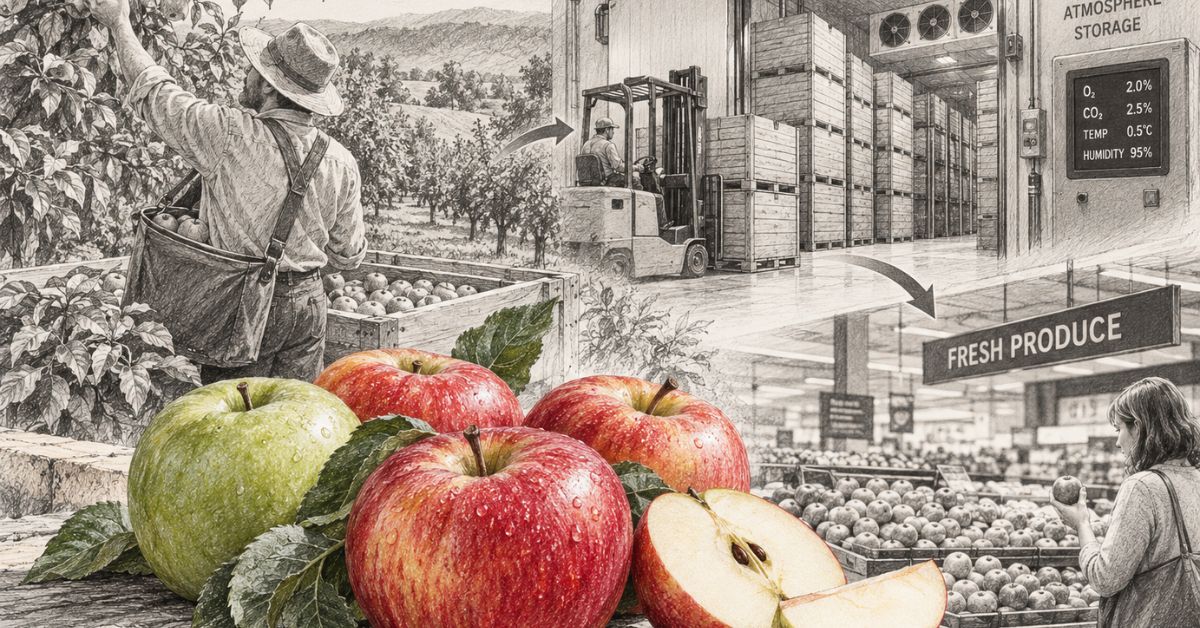
An apple can spend months in carefully managed storage before it reaches the fruit bowl. That does not mean every supermarket apple is months old, or that stored fruit is necessarily poor quality. The interesting part is how growers slow the ageing of fruit that remains alive after harvest.
An apple is one of the simplest things you can buy at the supermarket. Pick one up, check for bruises, perhaps give it a gentle squeeze, and put it in the trolley.
There is little to suggest that it might have a longer history than the shopping trip. It could have been picked recently. Depending on the variety, season and supply chain, it could also have been harvested months earlier. Both apples might look much the same.
In January 2026, ABC News reported on storage at the Orange Fruit Growers Co-operative in central New South Wales. Its reporting described controlled-atmosphere technology capable of keeping suitable apples in storage for periods approaching 12 months. That is an upper-end capability under appropriate conditions, not a claim that Australian apples typically spend a year in storage.
To understand the technology, start with a detail that is easy to overlook. An apple is still alive after it has been picked.
The apple doesn’t stop working when it leaves the tree
Once harvested, an apple no longer receives water and nutrients from its tree, but its cells continue to function. The fruit uses oxygen and releases carbon dioxide through respiration, drawing on stored energy. Changes associated with ripening also continue.
Ethylene, a naturally occurring plant hormone, plays an important role in apple ripening. Over time, the fruit’s firmness, aroma and balance of sugars and acids can change. Some changes improve eating quality; eventually others contribute to deterioration.
Commercial storage aims to slow those changes so that the fruit reaching a customer still has the texture and flavour expected of its variety. Temperature is one part of the answer. The air surrounding the apple is another.
A very sophisticated refrigerator
Cooling apples slows their metabolism. Commercial facilities also manage humidity to reduce moisture loss. But refrigeration alone has limits, which is why the apple industry uses controlled-atmosphere storage.
Ordinary air contains about 21 per cent oxygen. In a controlled-atmosphere room, operators reduce oxygen and manage carbon dioxide while maintaining suitable temperatures. Under the right conditions, this slows respiration and ripening. The fruit is not frozen or preserved like canned food. It remains biologically active, but at a reduced rate.
There is a balance to maintain. Too little oxygen can trigger undesirable changes in the fruit; excessive carbon dioxide can damage some varieties. Appropriate settings depend on variety, maturity at harvest and the intended storage period. Advanced systems, sometimes called dynamic controlled atmospheres, adjust conditions in response to indicators of how the fruit is behaving.
It takes more than putting apples in a cold room and leaving them there. The operator is managing a living crop throughout storage.
From the orchard to the following season
Australian apple harvests occur largely in the first half of the year, although the timing varies with growing region and variety. Shoppers can buy Australian-grown apples well beyond that period because storage extends the selling season.
An Australian apple purchased in spring may therefore have been harvested months earlier. That is a possibility, not a way to calculate the age of any particular apple. Different varieties, businesses and supply chains have different storage arrangements.
Cold storage also has a long history. Growers once relied on cellars and other naturally cool spaces to keep produce after harvest. Today’s controlled-atmosphere rooms bring refrigeration, gas monitoring and more precise management to the same basic problem: how to slow deterioration without spoiling the fruit.
The treatment that changes how apples respond to ethylene
Another postharvest technology is 1-methylcyclopropene, usually shortened to 1-MCP. Ethylene helps regulate ripening by interacting with receptors in fruit cells. 1-MCP interferes with that response, which can delay some changes associated with ripening, including softening.
This is different from using a substance to kill mould. Its purpose is to influence the fruit’s ripening response. In Australia, relevant 1-MCP products are regulated by the Australian Pesticides and Veterinary Medicines Authority and must be used according to their approved conditions.
The fact that the treatment exists does not mean every apple receives it. Use depends on the product, variety, producer and storage plans. Nor can a shopper determine from an apple’s appearance whether it has been treated. The important consumer fact is that postharvest treatments and atmospheric storage are distinct technologies, sometimes used as part of a broader storage program.
Why some apples turn floury
Most apple eaters have encountered the disappointing one: attractive skin, but flesh that feels soft, dry or granular rather than crisp and juicy.
That texture is often called mealiness. An apple’s crunch depends partly on how its cells and cell walls behave when bitten. During ripening and storage, changes in cell walls and the material connecting cells can affect whether the flesh fractures crisply or separates in a softer, more granular way.
Variety, harvest maturity and storage conditions all influence texture. Some varieties hold firmness better than others. Controlled-atmosphere storage is intended to delay quality loss, not to cause it. An apple that has been stored for months can still be crisp, while an apple with an appealing exterior can disappoint when cut open.
Does storage change nutrition?
It would be tempting to assume an apple picked yesterday must be nutritionally superior to one stored for several months. The evidence is more complicated.
Apples vary naturally in their nutritional composition. Variety, growing conditions, maturity and handling all matter. During storage, levels of particular compounds, including some vitamins and phenolic substances, may change. The amount and direction of change depend on what is being measured and the conditions involved.
That does not establish that stored apples are nutritionally equivalent to newly harvested apples. Equally, the duration of storage alone does not prove that an apple has become nutritionally poor. Dietary fibre remains one of the reasons apples are useful in the diet, even though some other characteristics can change over time.
Texture, flavour and nutrient levels are related aspects of quality, but they do not necessarily change at the same rate. A firm apple is not a laboratory test of its vitamin content.
Why the label doesn’t tell you when it was picked
Country-of-origin information can tell shoppers whether an apple was grown in Australia. It does not, by itself, identify the harvest date.
An Australian-grown apple might have been harvested recently or kept in storage. The origin statement cannot settle that question. Nor can its colour or firmness reliably reveal the date it left the tree.
Commercial growers and distributors may hold harvest and storage records, but the information normally displayed to consumers serves other purposes. This article makes no claim that retailers are generally required to display an individual apple’s harvest date. The applicable labelling requirements should be assessed separately from a consumer’s interest in that information.
If the harvest date matters to you, ask the seller or buy directly from a grower who can provide it. Buying local may make that conversation easier, but ‘locally grown’ is not automatically the same thing as ‘recently picked’.
The variety matters as much as the room
Long storage begins with decisions made in the orchard. Varieties differ in their rates of ripening, response to storage atmospheres and susceptibility to disorders. Harvest maturity matters too. Fruit picked too early may not develop the desired eating quality; fruit picked too late may have reduced storage potential.
Growers must judge when to harvest, how to handle the fruit and whether it is suited to extended storage. The storage facility then manages temperature, humidity and atmospheric conditions. A crisp apple on the supermarket shelf can be the result of many careful decisions made months before it is purchased.
What can shoppers actually do?
The most useful distinction is between an apple’s age and its eating quality. They are related, but not interchangeable.
Choose apples that are firm and free from obvious bruising or deterioration. Learn which varieties offer the sweetness, acidity and texture you enjoy. At home, refrigeration generally helps apples retain their quality longer than leaving them in a warm kitchen. Handle them gently: damage to the flesh can occur even when the skin appears mostly intact.
If you want to know when an apple was picked, ask. Don’t try to infer a harvest date from a shiny skin or a satisfying crunch.
A different understanding of fresh
There is a considerable amount of science behind the ordinary act of buying a crisp apple outside the harvest season. Fruit may be picked in autumn, moved into refrigerated storage, held in a carefully controlled atmosphere and released for sale months later. Throughout that period it remains alive, respiring slowly as its quality is managed.
We often use ‘fresh’ to mean ‘recently harvested’. With apples, the word can also describe fruit that has retained good eating quality through storage. Those ideas overlap, but they are not identical.
The next time you bite into a crisp Australian apple in spring, you probably won’t know exactly when it left the tree. Its crunch may owe something to the grower, the variety and an unusually sophisticated storage room.