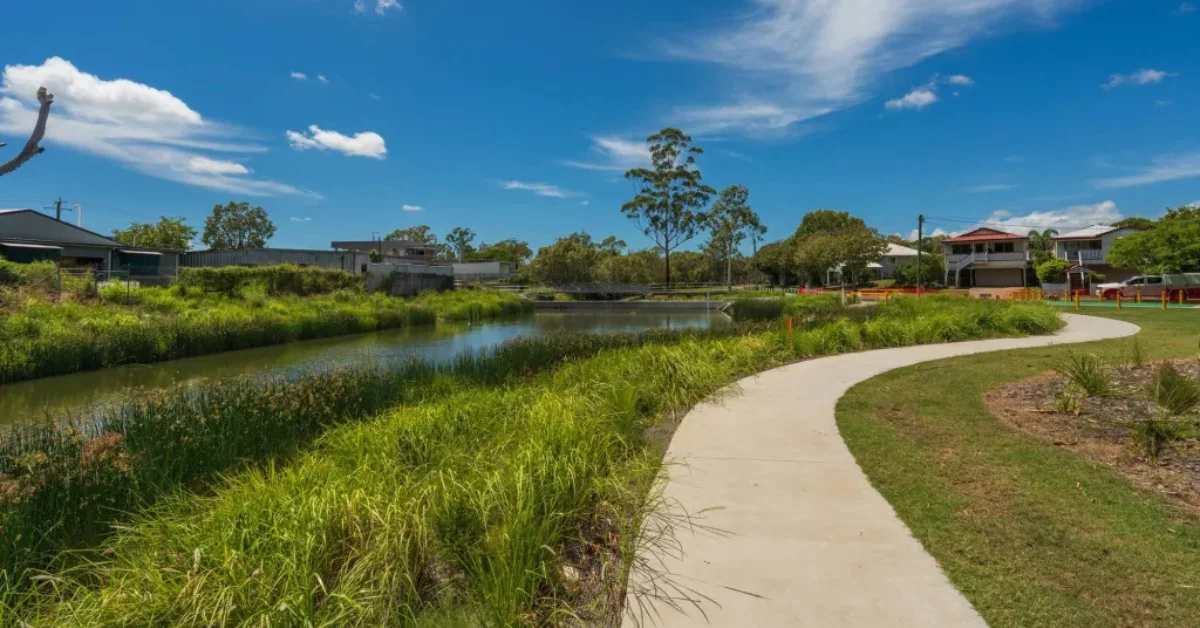




Keith Boden Wetlands Rehabilitation: Start Date Confirmed and Here’s What’s Planned

Rehabilitation works at the Keith Boden Wetlands at Shaw Park are set to commence on 25 May, subject to final scheduling and weather conditions.


Read: Keith Boden Wetlands Restoration Gains Momentum


The news came via an April 24 community update from Cr Adam Allan, who confirmed that Council officers have provided advice that the project is set to get underway next month.

“Thank you to the community for your patience and understanding while these complex works have been planned,” Cr Allan wrote in his Facebook post. “This is a surprisingly complicated project which entailed detailed design and bespoke project methodology in order to progress the project.”

A Wetland With a Long History and a Growing Problem

Photo credit: Google Maps/Caro Sierra

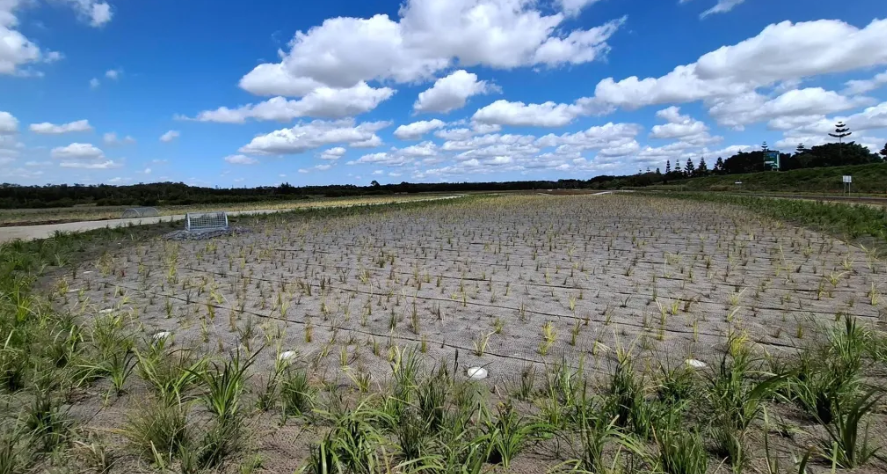
The Keith Boden Wetlands were originally constructed in 1998 with a clear environmental purpose: to filter sediment and pollutants from stormwater runoff before it flows into Kedron Brook and eventually Moreton Bay. After 25 years, accumulated sediment has taken a toll on the wetlands’ ability to function effectively.

Excessive sediment build-up has led to exposed mudbanks and decaying organic matter that have worsened despite recent rainfall events, degrading both water quality and local biodiversity in the process. As Cr Allan put it in his funding announcement, the wetlands are in need of TLC to keep working effectively.

Funding to carry out the rehabilitation was secured for the 2025-2026 financial year.

What the Works Will Involve

Photo credit: Google Maps/James Gibson

What can residents and park-goers expect once works begin? According to Cr Allan’s update, the project involves several stages of construction activity.

A temporary access track will first be built to allow construction vehicles to safely reach the site. Temporary detours and traffic control measures will also be put in place to protect pedestrians and cyclists using the area during the works.

The centrepiece of the project is the deployment of a floating excavator, which will work within a temporary bunded area inside the wetland. The excavator will remove the years of built-up sediment that has accumulated on the wetland floor. That material will be dewatered on-site before being transported off to a licensed facility, a requirement under the permits issued for the project.

Minor repairs to some of the retaining walls along the wetland’s edge are also planned as part of the scope of works.

Project signage with information and contact details will be installed on-site, so residents visiting Shaw Park will be able to stay informed as works progress.


Read: Community Calls for Action as Wavell Heights Wetlands Decline


A Complex Project With a Lot of Moving Parts

Cr Allan was candid about why it has taken time to get to this point. The project required detailed design work, a bespoke methodology, and a range of approvals and permits from the State Government, along with significant dialogue with State agencies to ensure the works could be completed safely and responsibly.

Cr Allan acknowledged the community’s patience throughout this process. Restoring the wetlands’ capacity to filter stormwater will benefit not only Shaw Park but the broader Kedron Brook catchment and Moreton Bay downstream.

Published 4-May-2026

The Tiny Pollinators Living at Our Lady of the Angels School in Wavell Heights

Our Lady of the Angels School in Wavell Heights is home to Australian native stingless bees, and the colony is playing an important role in the school’s gardens, student learning, and the local environment.


Read: Our Lady of the Angels’ School Secures Top-3 Finish at Opti-Minds State Final


They’re small, barely 4 mm long, jet black, and entirely stingless. The native bees living in hives on the grounds of Our Lady of the Angels School are quietly going about their work.

Our Lady of the Angels School has been caring for its native bee hives as part of its commitment to care for creation and sustainability, and the person behind the hive’s upkeep is Mr Aspin, the school’s groundsman. Over the recent school holidays, Mr Aspin put considerable care and creativity into the area surrounding the hive. The school community showed their appreciation, giving Mr Aspin a shoutout on the school’s Facebook page for his efforts.

This term, the school’s commitment to its native bee program is growing. A new hive is set to be added to the grounds, with an incursion planned to give students a hands-on introduction to their new six-legged neighbours.

Learning in the Real World

For students at Our Lady of the Angels School, the hives offer real-life learning opportunities. Native bees help pollinate plants and flowers, supporting biodiversity and keeping the school’s gardens thriving. The school sees the program as a meaningful way to connect children with the natural world and explore themes of care for creation and sustainability.

By caring for native bees, students come to understand how small actions can make a big difference for the environment.

About Australian Native Stingless Bees

Photo credit: aussiebee.com.au

Australia is home to eleven species of native stingless bees. Small, black, and measuring just 4 mm in length, they are tropical by nature and only thrive in warm parts of Australia, including Queensland, northern areas of Western Australia and the Northern Territory, and north-eastern New South Wales. Wavell Heights sits well within the climate range where stingless bees thrive.

They pose no sting risk, and as pollinators, they play an important part in keeping gardens and green spaces healthy.

They can be kept in a natural log or a hive box and are considered easy and safe to maintain in a backyard. For residents across Wavell Heights and surrounding suburbs with a veggie patch or flowering garden, it’s an option worth exploring.


Read: Double Success for Our Lady of the Angels’ at Rugby 7s


Looking Ahead

With a new hive on the way and an incursion planned for this term, the native bee program at Our Lady of the Angels School looks set to grow. The school has made clear that caring for these tiny creatures is about more than gardening — it’s about teaching the next generation to care for the world around them.

And the bees? They’ll just keep doing what they do best, quietly, diligently, and without a single sting.

Published 28-April-2026

The Hidden History of the Veteran Who Built a Wavell Heights Empire

The iconic local landmark known as the Hamlin House is at the centre of a historical mystery after modern research proved the home was actually built by a different family over a decade earlier than official records ever suggested.


The Detective in the Archives

While the community has long believed the large home on O’Donnell Street was built in 1928, architectural historian Marianne Taylor recently found evidence that changes the entire story. By examining old title deeds, Taylor found a specific stamp from the Workers Dwellings Board. This discovery shows that the house was actually finished around late 1916 or early 1917. 

The records reveal that Andrew and Agnes Lonie were the true original owners who moved onto the land long before the suburb even had its current name. This shift in the timeline means the house stood through the end of the First World War and saw the neighborhood transform from rough bushland into a modern residential area.

A Hero Returns Home

Even though he did not build the house, Frederick Hamlin remains a massive part of the local identity. As a veteran of the First Australian Imperial Force, Hamlin returned from the war and used a specialized loan for soldiers to buy the property in 1920. The house itself was a bit of a rebel for its time because it did not follow the trendy styles of the 1920s. 

Instead, it was built as an asymmetrical bungalow with a roof that swept down over the front porch and featured unique triple windows. It was much larger than most houses built for veterans, likely because the Hamlin family needed the extra space for their growing number of children.

From Bushland to Flower Beds

Photo Credit: Google Maps

Before the area became the busy suburb of Wavell Heights, it was known as West Nundah and was mostly filled with pineapple farms and dairy cows. The Hamlin family helped change the face of the district by starting a nursery business right in their backyard. This business eventually became one of the biggest in the region, especially during the building boom after the Second World War. 

As new families moved into the area, they visited the Hamlins to buy award-winning flowers and shrubs to decorate their new front yards. Local experts believe that many of the old, beautiful trees still standing in the suburb today probably started as small seedlings in the Hamlin nursery.

The Name that Stayed

The suburb we know today only got its name in 1941 during a patriotic concert at the Imperial Theatre. While planners originally thought about calling the area Beverly Hills, they chose to honour General Sir Archibald Wavell instead. Through all these changes, the house at 35 O’Donnell Street stayed in the Hamlin family for nearly 60 years. 


Even though the “House Detective” has now proven the Hamlins weren’t the first ones to live there, their long history of gardening and community service is likely why everyone forgot about the original 1916 builders. The home remains a sturdy piece of the past that connects the early farming days to the modern streets of today.

Published Date 28-April-2026

Norths Rugby Club Reels After Alleged String of Ten Break-Ins in 18 Months

The Norths Eagles rugby club is facing a mounting financial and emotional toll following a series of alleged break-ins at their Hugh Courtney Oval clubhouse. “The Nest” has been hit at least ten times in the last 18 months, with the most recent blow involving three consecutive nights of alleged thefts and property damage that have left club volunteers struggling to keep up with repairs.


CCTV footage from the clubhouse shows groups of young people inside the facility on multiple occasions, taking soft drinks, packaged goods, and bottled water. The most recent run of three consecutive night break-ins has added to a financial toll that club president Shaun McKinnon estimates included $1,300 in goods lost in a single incident alone.

Beyond the stolen stock, the alleged offenders have set the club’s wooden outdoor tables alight on multiple occasions, destroying custom-made property that cannot simply be replaced off a shelf.

The club, known to members and supporters as The Nest, is one of Brisbane’s most historically significant rugby union clubs. Tracing its origins to the Teachers Training College Football Club in 1933, Norths has spent more than 90 years developing players at every level, from juniors through to Wallabies, with alumni including Will Genia, Greg Cornelsen and Michael O’Connor. It competes in the Queensland Premier Rugby competition, the highest level of club rugby in the state below Super Rugby.

The Pattern the Club Keeps Seeing

What frustrates club officials is not just the frequency but the consistency of the method. McKinnon says the alleged intruders access the clubhouse the same way each time, finding the same entry point regardless of security improvements. Each repair and upgrade is followed by another break-in using the same approach, creating a cycle that drains both money and morale.

One incident about a month ago unfolded differently. A community member arrived at the club at around 7:00 pm to drop off supplies and spotted a group of young people on the roof of the clubhouse. Police responded quickly, but as officers arrived, the alleged offenders fled on e-bikes, heading onto the Kedron Brook Bikeway and disappearing before police could locate them.

That detail connects to a broader pattern in the area. Police have been conducting targeted operations along the Kedron Brook Bikeway in recent years in response to complaints about the use of non-compliant and unregistered electric bikes, including enforcement action involving young people. The bikeway, which runs almost 20 kilometres from Mitchelton to Nundah and passes close to Hugh Courtney Oval, provides rapid movement through the northern suburbs and has featured in incidents extending well beyond the Wavell Heights area.

A Community Club Absorbing Costs It Was Never Built to Carry

Norths Eagles operates, like most community rugby clubs, on tight margins that depend heavily on match-day income, bar and canteen takings, memberships and sponsorships. The Australian Sports Foundation has noted that the club’s infrastructure and facilities depend significantly on grant funding, given the difficulty of funding capital upgrades through operating revenue alone. Against that backdrop, repeated losses to theft and property damage are not a minor inconvenience. They represent a direct hit to the resources the club uses to run junior programmes, maintain fields and support its players.

McKinnon has called on the Wavell Heights and broader northern suburbs community to back the club in a practical way: come out to home games at Hugh Courtney Oval during the Queensland Premier Rugby season, and support the bar and canteen while there. For a club that has been running in this community for over nine decades, the ask is a reminder that local sporting clubs survive on local support, and that support matters most when things are difficult.

How to Back the Eagles

Norths Eagles play their home games at Hugh Courtney Oval, 128-150 Shaw Road, Wavell Heights. The 2026 Queensland Premier Rugby season is currently underway. Fixture information, news and sponsorship enquiries are available via the club’s website at northsrugbyclub.com or through their Facebook page. Anyone with information about the alleged break-ins can contact Policelink on 131 444 or report anonymously through Crime Stoppers on 1800 333 000.


Published 17-April-2026

Hamilton Road Intersection Upgrade Set to Improve Safety at Wavell Heights Crossing

Traffic lights are coming to the Hamilton Road and Spence Road intersection in Wavell Heights, with plans lodged to overhaul one of the suburb’s busiest and most hazardous daily crossing points.


The Hamilton Road and Spence Road intersection carries heavy traffic throughout the day, with long wait times and limited visibility making it difficult for drivers to safely enter and exit Spence Road. The planned upgrade will install traffic signals at the intersection, along with a series of improvements designed to make the crossing safer and more reliable for drivers, pedestrians and bus passengers alike.

The project is currently in progress, with the construction timeline still being finalised pending funding confirmation.

What the Upgrade Involves

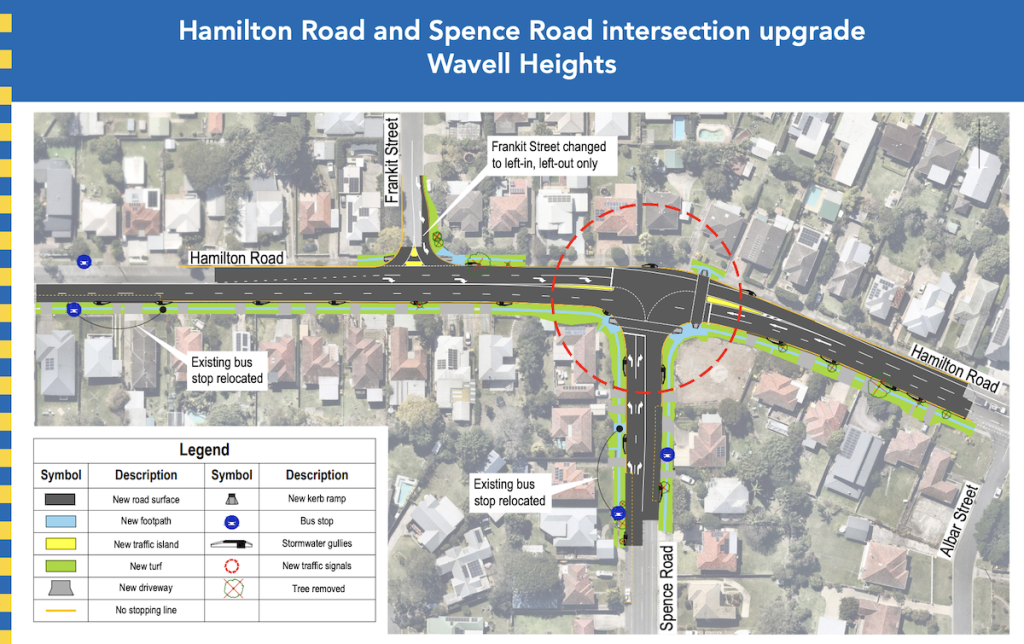
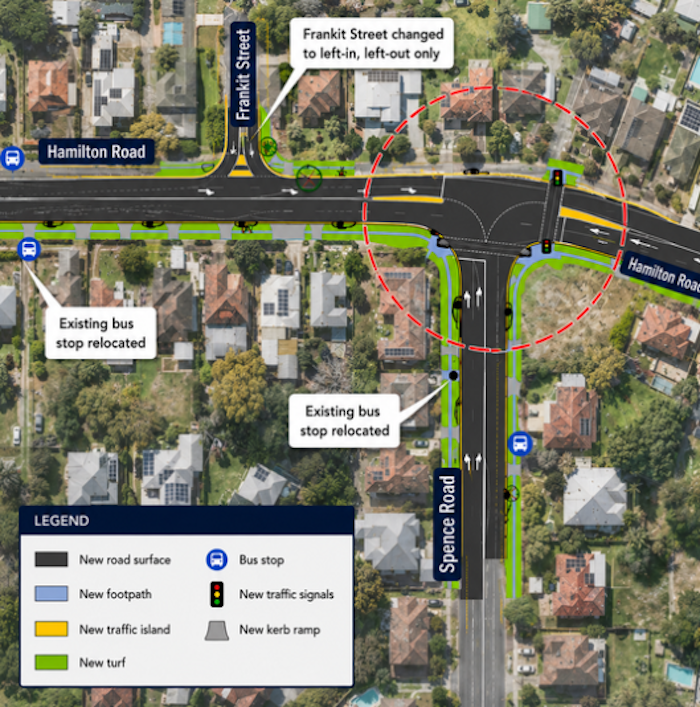
The centrepiece of the works is a full set of traffic signals at the intersection, including signalised pedestrian crossings. The right-turn lane on Hamilton Road into Spence Road will be extended, and both corners of Spence Road at Hamilton Road will be widened to formalise two westbound traffic lanes on approach to and through the intersection.

Photo Credit: BCC

Bus stops will shift as part of the works. The westbound stop on Hamilton Road (stop 43) moves 30 metres west, and the northbound stop on Spence Road (stop 42) moves 30 metres south. Footpaths will be upgraded, new kerb ramps installed, and stormwater infrastructure on both roads within the project area will be renewed. New road pavement, signage, line marking and landscaping complete the scope.

One change will be permanent from the outset: access from Frankit Street onto Hamilton Road will become left-in, left-out only. A new pedestrian refuge on Frankit Street at Hamilton Road will also be installed. Residents who currently turn right out of Frankit Street will need to adjust their routes once construction begins, and the project team is available to discuss alternative travel options.

A Corridor with a History of Safety Concerns

Hamilton Road has been a focus of road safety investment for several years. The intersection with Bilsen Road was upgraded under the Black Spot Program after recording nine crashes between 2015 and 2021, all of which required medical treatment or hospitalisation. That project delivered dedicated right-turn pockets, updated signal phasing and relocated bus stops, and is now complete.

The Spence Road intersection presents a similar set of challenges. High traffic volumes, extended wait times and limited sightlines have made it difficult for drivers to safely navigate the crossing, mirroring the conditions that prompted action at Bilsen Road.

A Safer Street for the People Who Use It Every Day

For residents living near the intersection, this upgrade addresses a problem that has been part of their daily routine for years. Hamilton Road serves as one of the key east-west connectors through Wavell Heights’ inner north, and the Spence Road junction has long added unnecessary time and uncertainty to morning and afternoon trips.

The inclusion of signalised pedestrian crossings is a meaningful addition for those who travel the area on foot, where crossing Hamilton Road currently requires careful judgement and a degree of patience.

Broader traffic studies have pointed to ongoing pressure across Wavell Heights roads, with congestion on surrounding arterials including Sandgate Road and Gympie Road continuing to push traffic onto local streets. Intersection-level upgrades like this one address safety at specific points, and combined with previous works along the corridor, represent a sustained effort to improve conditions for the community.

How to Stay Across the Project

The construction program is still being finalised, and more detail on timing will be shared once that process is complete. Residents can register for project update emails through this link.

For questions, including advice on alternative routes around the Frankit Street access change, contact the project team on 07 3178 5413 (Monday to Friday, 8.30am to 4.30pm), or email cityprojects@brisbane.qld.gov.au with the subject line “Hamilton Road and Spence Road intersection upgrade.” Written enquiries can be directed to Infrastructure Services, GPO Box 1434, Brisbane QLD 4001. General enquiries can be made to 07 3403 8888, available 24 hours a day, seven days a week.


Published 31-March-2026

St Kevin’s Students Shave Heads to Support Cancer Research

Students and staff at St Kevin’s Catholic Primary School in Geebung are preparing to take part in a head-shaving fundraiser this Easter, joining a national effort to support Australians living with blood cancer.


The school is set to host its Shave for a Cure event on Thursday, 2 April, where 12 students and three staff members will either shave or cut their hair. The initiative is part of the Leukaemia Foundation’s World’s Greatest Shave campaign, which raises funds for research and support services for people diagnosed with blood cancer.

The event is also personal for the school community. Organisers have confirmed the fundraiser is being held in support of families affected by cancer, including one family connected to the school who has recently experienced the impact of the disease.

Students Stepping Up 

Participants have volunteered to take part as a show of support and solidarity with those undergoing treatment. The act of shaving or cutting hair is often linked to raising awareness about the physical effects of cancer therapies, particularly hair loss.

The school’s leadership has shared that the event aims to encourage empathy among students while giving them a practical way to contribute to a wider cause. Assistant Principal Religious Education Kristin Byrne is expected to speak about the purpose of the fundraiser, highlighting its role in building compassion and community engagement.

Students will also share their perspectives during the event, explaining why they chose to take part and what the cause means to them.

Supporting Research and Care

Funds raised through the event will go towards the Leukaemia Foundation’s programs, which include funding medical research and providing practical and emotional support to patients and their families.

The World’s Greatest Shave campaign has been running for more than two decades and continues to be one of Australia’s largest fundraising efforts for blood cancer. Donations collected through school events like this contribute to ongoing research into treatments and help fund services such as accommodation, transport assistance and counselling.

The St Kevin’s fundraiser will take place on school grounds, with the community invited to attend and support participants as they take part in the head-shaving activity.


St Kevin’s School joins thousands of Australians who continue to support efforts to improve outcomes for people affected by blood cancer.

Published 1-April-2026

Wavell Heights Student Zahra Patel Named Runner-Up at 2026 WIMARQ Resources Awards for Women

Wavell State High School Year 12 student Zahra Patel has been named runner-up in the Exceptional Female QMEA Student Award at the 2026 Women in Mining and Resources Queensland International Women’s Day Luncheon and Resources Awards for Women, recognising years of dedication to STEM pathways and the resources sector.



Zahra attended the Brisbane luncheon alongside fellow Wavell student and University of Queensland Science Ambassador Nia Benson and teacher Mr Drago, representing a school that has been part of the Queensland Minerals and Energy Academy since its founding in 2005. The event brought together industry leaders, keynote speakers and students from across Queensland to celebrate the contribution women are making to the resources and energy sector. Attendees heard from keynote speaker Claire Parkinson, a former mining executive and prison governor, who shared insights on leadership and career resilience.

The runner-up recognition in the Exceptional Female QMEA Student category reflects Zahra’s sustained involvement in STEM opportunities over many years, rather than a single standout achievement. She celebrated the result with her family, who were present at the luncheon. Zahra is also a participant in the WIMARQ Mentoring Program, which pairs female Year 12 students with women working in the resources sector, providing one-on-one guidance and professional support as they complete their final year of school and plan for what comes next.

What the QMEA Pathway Offers Students

The Queensland Minerals and Energy Academy is designed to encourage students to enter careers in the minerals and energy sector, providing clear pathways into one of the state’s most innovative and economically important industries. As Australia’s largest industry-led initiative, QMEA bridges education and industry, inspiring students to pursue pathways in the resources sector and STEM fields through innovative programmes that prepare students for future careers and support teachers in delivering engaging STEM education.

Wavell State High School has been a foundation partner school of the QMEA since the academy’s inception in 2005. That two-decade relationship has given Wavell students consistent access to mine site excursions, engineering camps, curriculum-linked forums, industry mentoring and nationally recognised qualifications in resource and infrastructure operations. QMEA Ambassadors, like Zahra, take on additional leadership responsibilities within the programme, representing their school at major industry events and promoting resources and STEM careers to younger students.
The results of the QMEA model are measurable. Female students at QMEA schools who entered a post-school apprenticeship or traineeship did so in the mining industry at almost five times the rate of students from non-QMEA schools. For young women in particular, the combination of industry exposure, mentoring and peer networks that QMEA and WIMARQ provide significantly changes the likelihood of pursuing a career in a sector that has historically underrepresented them.

WIMARQ and the Mentoring Programme

The Women in Mining and Resources Queensland organisation works to attract, retain and advance women across Queensland’s resources sector through advocacy, events and structured mentoring. The WIMARQ Mentoring Program that Zahra participates in pairs selected female Year 12 students with experienced women from the resources industry, creating a direct line of connection between school life and professional careers. For students navigating the transition from Year 12 into university, apprenticeships or employment, that kind of personal guidance from someone already working in the field carries practical value that no classroom programme can replicate.

The International Women’s Day Luncheon and Resources Awards for Women is the centrepiece event of WIMARQ’s annual calendar, drawing senior industry figures and student participants from across Queensland together to recognise excellence and build the networks that sustain women’s participation in the sector over the long term.

Why This Matters to the Wavell Heights Community

For families in Wavell Heights and the surrounding northern Brisbane suburbs, Zahra’s recognition is a reminder that Wavell State High School offers its students access to opportunities that extend well beyond the standard secondary curriculum. The school’s two-decade partnership with the QMEA has opened doors for hundreds of Wavell students into careers in engineering, resources, energy and related STEM fields, and Zahra’s runner-up award is one of the most visible expressions of what that partnership can produce.
For young women in the community who are weighing up their options beyond Year 12, the combination of QMEA membership, WIMARQ mentoring and industry events like the International Women’s Day Luncheon represents a genuine pathway into one of Queensland’s most economically significant sectors. Queensland’s resources sector contributed $116.8 billion to the state economy in the most recent financial year and supports the jobs of more than 532,000 Queenslanders, making the pipeline of skilled graduates into the sector a matter of real economic importance for the state.

Students at Wavell State High School interested in the QMEA programme can speak with their school’s QMEA coordinator, or find more information at qmea.org.au. Information about the WIMARQ Mentoring Program is available at wimarq.com.au.


Published 13-March-2026.

Zeehan Street Home Heads to Auction as Wavell Heights Knockdown Rebuild Boom Continues

A brand new five-bedroom home at Zeehan Street in Wavell Heights is heading to auction, and the story behind it is one that is becoming increasingly familiar across Brisbane’s middle ring suburbs. Where a former home once stood, a knockdown rebuild has produced an architecturally designed residence that signals just how rapidly the suburb is changing.


Read: Pfingst Farmhouse in Wavell Heights: A Local Heritage Treasure


Crafted by Domrafi Property and designed in collaboration with architect Daniel Zullo of DZ Architects, the property at 33 Zeehan Street features sculptural curves, layered timber and stone finishes, and a curved in-ground pool overlooking a large backyard. It’s scheduled for auction on 14 March.

Photo credit: Place

David Colley, founder of Domrafi Property, spent 15 years running a bathroom and tiling business before deciding to back himself as a developer. He says the shift was deliberate. He wanted to build for himself rather than for clients, and has since completed five knockdown rebuild projects focused on Brisbane’s northern suburbs, including Wavell Heights and Nundah, where large blocks and established neighbourhoods continue to draw families.

33 Zeehan Street before the rebuild (Photo credit: Google Street View)

He says the pace of change across Wavell Heights over the past five years has been striking, with older weatherboard homes increasingly replaced by architect designed residences, and that development has been good for the growth of the suburb.

But Mr Colley is candid about the pressures facing developers in the current market. Finding suitable sites has become increasingly competitive, and Wavell Heights has become an expensive market for knockdown properties. He says a knockdown rebuild project in the suburb now averages just over $3 million in total cost, with suitable knockdown properties commanding prices in the high one millions. His advice to anyone considering a similar project is to run the numbers early and run them carefully.

Zeehan Street
Photo credit: Place

That caution is echoed by RSM Australia national real estate lead and taxation lawyer Adam Crowley, who says he is fielding a growing number of enquiries from everyday homeowners and first time developers across Brisbane. He says the profile of people entering the knockdown rebuild space has broadened well beyond the construction industry, with doctors, surgeons and other professionals increasingly exploring whether to renovate, rebuild or subdivide their existing block.

Mr Crowley warns that the tax implications of building and selling can catch people off guard. GST obligations, capital gains tax and the limits of the main residence exemption are areas where assumptions regularly prove costly. He points specifically to duplex projects where one dwelling is sold without ever having been a primary residence, noting that in those cases no main residence exemption applies at all. His advice is consistent: get proper structuring advice before breaking ground, because untangling the consequences afterwards is far harder.

Zeehan Street
Photo credit: Place

Place Ascot agent Drew Davies, who is marketing the Zeehan Street property and has observed the broader trend across Brisbane’s middle ring, says the new generation of knockdown rebuilds is less about size and more about quality. He says boutique family backed projects are increasingly competing directly with traditional developers on craftsmanship and architectural ambition, bringing a level of finish to suburban streetscapes that many would not have expected to see in these neighbourhoods.


Read: Alby’s Cafe: The Newest Brunch Spot for Families in Wavell Heights


For Wavell Heights, the change is already visible from the street. The question for homeowners sitting on a sizeable block is whether the opportunity to be part of that transformation still stacks up — and according to those closest to the market, it can, provided the groundwork is done properly.

Published 16-March-2026

BotBuilders Robotics Settles Into Geebung Base, Sets Sights on World Championships

North Brisbane robotics club BotBuilders Robotics has relocated to new premises in Geebung, as the team gears up for an international competition in Houston, Texas.


Read: Wavell State High Students Shine in Robotics and Engineering


The Geebung location hosts the club’s weekly sessions, where members drawn from various schools across north Brisbane meet to design, build, and code robots. The club is now preparing for an international competition that will take them to the United States.

BotBuilders is bound for the FIRST Robotics Competition World Championships in Houston, Texas, at the George R. Brown Convention Center from 16–19 April 2025. The annual event, presented by BAE Systems, is the culminating competition of the FIRST robotics season, drawing student teams from across the globe. 

The four-day championship unites over 40,000 students, mentors, and participants from around the world. The team has been continuing to refine its robot ahead of the trip. To help cover travel and competition costs, BotBuilders has established a crowdfunding campaign through Chuffed.org to raise funds for the journey.

Photo credit: Facebook/Cr Adam Allan

Cr Adam Allan visited the team at their Geebung premises recently and reported the relocation had gone smoothly. “They moved into new premises in Geebung a little while ago but have not missed a beat and the new location is working well for them,” he wrote on his Facebook page. 

During the visit, Cr Allan also had the opportunity to watch the team’s robot in action. “It will be great experience for the young team as they will be competing against and learning from the best in the world,” he wrote. Cr Allan encouraged anyone with an interest in robotics to reach out to the club directly.

Beyond competition, BotBuilders actively mentors other community and school teams and delivers a Robotics Immersion Program designed to build STEM skills and confidence in younger students.


Read: Gerns Factory Residence: A Historic Gem in Geebung


About BotBuilders Robotics

Photo credit: Google Maps/BotBuilders Robotics

BotBuilders Robotics is a not-for-profit, community-based team established in 2016 in north Brisbane. Members are drawn from various schools and meet each week to design, build, and code robots.

The club participates in FIRST Lego League, FIRST Tech Challenge, and FIRST Robotics Competition, and actively mentors other community and school teams. It also delivers a Robotics Immersion Program aimed at developing skills and confidence in STEM among younger students. 

Published 28-February-2026

Housing Development Planned For Former Depot Site In Banyo

A large parcel of publicly owned land in Banyo is being prepared for release to the market for residential development, with the site expected to deliver up to 400 homes.


First Release Site Identified In Banyo

The site is located on Blinzinger Road in Banyo and is described across program and reporting material as being around six hectares, with one program description listing it as 6.4 hectares. The land was previously used as an Energex depot and has been fenced and unused for about a decade.

Material describing the site states it is close to public transport, shops and schools, and indicates it is suitable for residential development. The site has also been linked to earlier industrial operations connected to the electricity network in Brisbane’s north, with reporting describing its past use as a depot and associated facility.

Banyo housing development
Photo Credit: Pexels

How The Land Activation Program Works

The Land Activation Program is designed to unlock underutilised publicly owned land for housing by bringing surplus sites to market for development. It allows private developers to identify and register interest in underutilised Queensland-owned land that may be suitable for housing outcomes.

Public sector agencies are also expected to identify land that is no longer required or has no reasonably foreseeable operational use, so it can be released for housing. Economic Development Queensland is responsible for assessing proposals using criteria intended to confirm sites are genuinely surplus and suitable for residential development, including mixed-use outcomes where applicable.

Program material also states Economic Development Queensland can use planning and development powers under the Economic Development Act 2012 to help fast-track housing delivery by addressing site constraints and infrastructure challenges.

For unsolicited industry proposals, program information states Economic Development Queensland will investigate nominated sites and provide advice on suitability within 30 business days.

Economic Development Queensland
Photo Credit: Pexels

Affordability Settings Remain In Focus

The approach differs from earlier land partnership models because the sale of publicly owned sites to private developers is not framed as requiring social or affordable housing components. Supporters of the approach argue fewer conditions can help projects proceed faster. Critics argue the absence of mandated affordability settings limits the likelihood of direct benefit for low-income households or people waiting for social housing.

Reporting on the shift has also referenced a KPMG review of the former Ground Lease Model, which was described as estimating a cost of $1.7 billion for 715 dwellings.

What Happens Next


The Banyo land release is identified as the first site to be brought to market under the program, with further sites expected to follow progressively across Queensland as activation strategies are developed. No detailed construction schedule or housing mix has been set out in the material provided.

Published 30-Jan-2026. Updated 16-Feb-2026