



Wavell Heights Among 31 Suburbs in Wastewater Inspection Program

Residents in Wavell Heights and several surrounding northside suburbs may see Urban Utilities officers inspecting private properties in the coming months as part of a program aimed at reducing wet-weather wastewater overflows.


Wavell Heights is among 31 Brisbane suburbs covered by the Wet Weather Overflow Reduction Program, which runs until 31 December 2026. Other northside suburbs on the list include Nundah, Nudgee, Banyo, Virginia, Aspley, Zillmere, Taigum, Boondall, Deagon, Shorncliffe, Bracken Ridge and Bald Hills.

Urban Utilities says the program targets areas where wastewater overflows have repeatedly occurred during wet weather or where pumping stations and treatment plants have recorded unusually high inflows.

The utility is trying to determine how stormwater is entering a wastewater system that is not designed to carry large volumes of rainwater. Possible sources include cracked pipes, defects around maintenance holes and non-compliant plumbing or drainage connections on private properties.

During heavy rainfall, stormwater entering the wastewater network can significantly increase flows and contribute to overflows, particularly where the system is already under pressure.
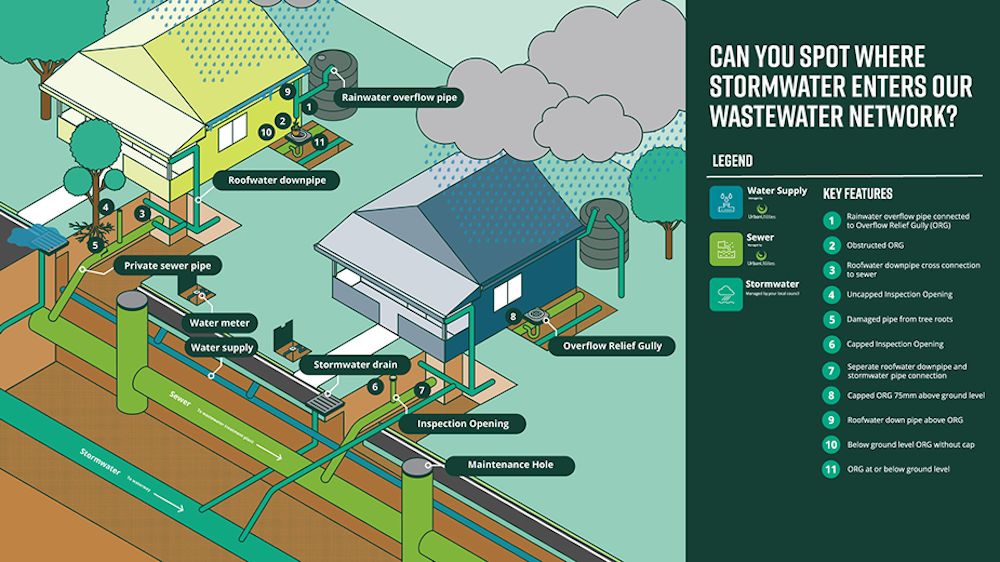
Photo Credit: UrbanUtilities

How Smoke Testing Works

To identify where stormwater may be entering the wastewater network, crews use smoke testing on wastewater pipes and private plumbing. Separately, Urban Utilities uses measures including CCTV inspections and pipe cleaning as part of its broader sewer maintenance work. Non-toxic smoke is pumped into the wastewater lines to trace unwanted flow. 

In a correctly connected system, the smoke should travel through the wastewater pipes and escape through normal plumbing vents. If smoke emerges from stormwater drains, downpipes or other unexpected locations, it can indicate a defect or an incorrect connection.
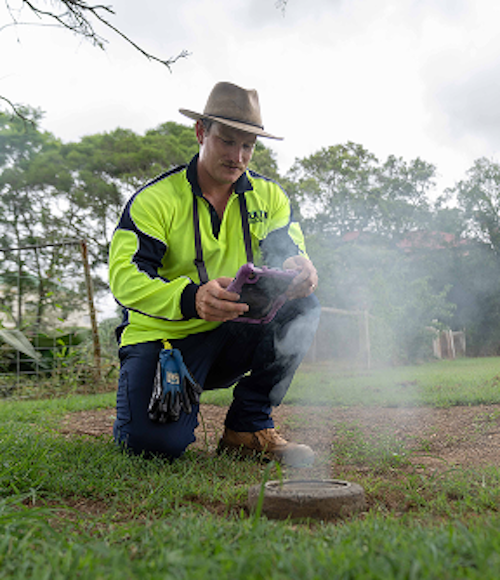
Photo Credit: UrbanUtilities

Property Access and Inspector Powers

Under Queensland legislation, authorised officers operating within an approved inspection program have statutory powers to enter private properties at reasonable times without prior occupier consent. However, the inspection-program powers have clear limits: officers cannot use those powers to enter any part of a property where a person resides.

Where an occupier is present, officers must make a reasonable attempt to identify themselves, explain the purpose of the entry and advise that the Act permits entry without consent. For an approved inspection program, they must also provide details of the program.

Public Network vs. Private Responsibilities

Urban Utilities says that excess wet-weather flow stems from a mix of local topography, public infrastructure defects, and private plumbing issues. While the program allows testing on private land, an inspection does not automatically mean a property is defective or that the homeowner will incur immediate repair costs. 


The testing is intended to identify where stormwater is entering the network and help inform targeted action. Depending on what is found, further work may involve private plumbing, Urban Utilities infrastructure or both.

For northside residents, knowing why access may be sought, what officers are permitted to inspect and what happens when a defect is identified will be important as testing continues.

Published 5-Aug-2026

Housing Development Planned For Former Depot Site In Banyo

A large parcel of publicly owned land in Banyo is being prepared for release to the market for residential development, with the site expected to deliver up to 400 homes.


First Release Site Identified In Banyo

The site is located on Blinzinger Road in Banyo and is described across program and reporting material as being around six hectares, with one program description listing it as 6.4 hectares. The land was previously used as an Energex depot and has been fenced and unused for about a decade.

Material describing the site states it is close to public transport, shops and schools, and indicates it is suitable for residential development. The site has also been linked to earlier industrial operations connected to the electricity network in Brisbane’s north, with reporting describing its past use as a depot and associated facility.

Banyo housing development
Photo Credit: Pexels

How The Land Activation Program Works

The Land Activation Program is designed to unlock underutilised publicly owned land for housing by bringing surplus sites to market for development. It allows private developers to identify and register interest in underutilised Queensland-owned land that may be suitable for housing outcomes.

Public sector agencies are also expected to identify land that is no longer required or has no reasonably foreseeable operational use, so it can be released for housing. Economic Development Queensland is responsible for assessing proposals using criteria intended to confirm sites are genuinely surplus and suitable for residential development, including mixed-use outcomes where applicable.

Program material also states Economic Development Queensland can use planning and development powers under the Economic Development Act 2012 to help fast-track housing delivery by addressing site constraints and infrastructure challenges.

For unsolicited industry proposals, program information states Economic Development Queensland will investigate nominated sites and provide advice on suitability within 30 business days.

Economic Development Queensland
Photo Credit: Pexels

Affordability Settings Remain In Focus

The approach differs from earlier land partnership models because the sale of publicly owned sites to private developers is not framed as requiring social or affordable housing components. Supporters of the approach argue fewer conditions can help projects proceed faster. Critics argue the absence of mandated affordability settings limits the likelihood of direct benefit for low-income households or people waiting for social housing.

Reporting on the shift has also referenced a KPMG review of the former Ground Lease Model, which was described as estimating a cost of $1.7 billion for 715 dwellings.

What Happens Next


The Banyo land release is identified as the first site to be brought to market under the program, with further sites expected to follow progressively across Queensland as activation strategies are developed. No detailed construction schedule or housing mix has been set out in the material provided.

Published 30-Jan-2026. Updated 16-Feb-2026

Banyo Rated No. 1 Brisbane Suburb with Best Access to Schools

Banyo, the residential/industrial suburb 13 kilometres north of Brisbane CBD, emerged as the number one suburb with the best access to education. This community in the Northgate Ward scored 10 out of 10 in a study on the most livable places in Australia.

The Domain Liveability study, which was released on the 18th of Nov 2019, looked into 18 indicators to determine the quality of life of its residents. The scores for access to both primary and secondary schools, however, were based on proximity and not the quality and performance of the schools.  

Study co-author Daniel Terrill said that proximity is significant for many families since there are faced with challenges like travel time, drop-offs and pick-ups. Having schools near where residents live lowers travel times and presumably, short travel times are better for the parents and the children.

Photo Credit: Domain Liveability


Aside from Banyo, Chermside West, Clontarf, Ferny Grove and Kelvin Grove also scored high on school accessibility. In Kelvin Grove, open homes are popular with families because they want to secure a house in a school catchment area. People buy houses in this suburb not necessarily to live in it but to rent it out first until such time that they would actually need it.

According to The Good Schools Guide, there are 76 primary and secondary schools within and around Banyo. Based on the NAPLAN, Earnshaw State College at the corner of Earnshaw and Tufnell Road in Banyo is the most improved Brisbane North school for 2019.